

This article’s eye-catching title may look like clickbait – but, having worked for many years with the product, I’ve come to ask myself if a large, automated, system consisting of many components interacting with each other could be described as alive. After all, in the rare circumstances when the Intelligence Server conks out, we often refer to it as dead – and for that to happen, it had to be alive in the first place, no ? it can even resurrect itself, which opens up a whole new avenue of debate…
Before we proceed, a disclaimer and some acknowledgments:
I am writing this in my personal capacity. While I work for MicroStrategy, I am in no way describing any future functionality that I know about. This is purely a theoretical exercise, for my benefit and that of my few readers.
I have taken advantage of ChatGPT to ask questions, and of DALL-E to generate some of the images in this article. The rest of the text is my own work.
Let’s define a few things
It’s 2023, and I have taken a habit of asking a famous AI what it thought of interesting questions. So here we are:
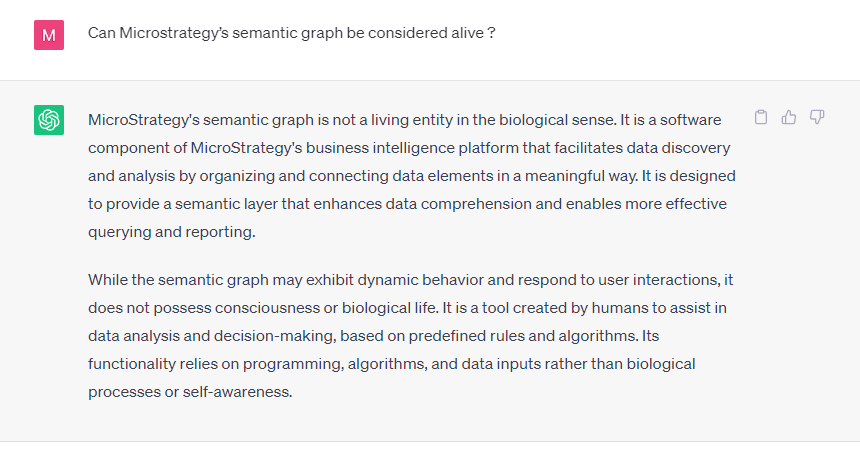
I particularly like ChatGPT’s first sentence: MicroStrategy’s semantic graph is not a living entity in the biological sense. Let’s ask what determines if something is alive:
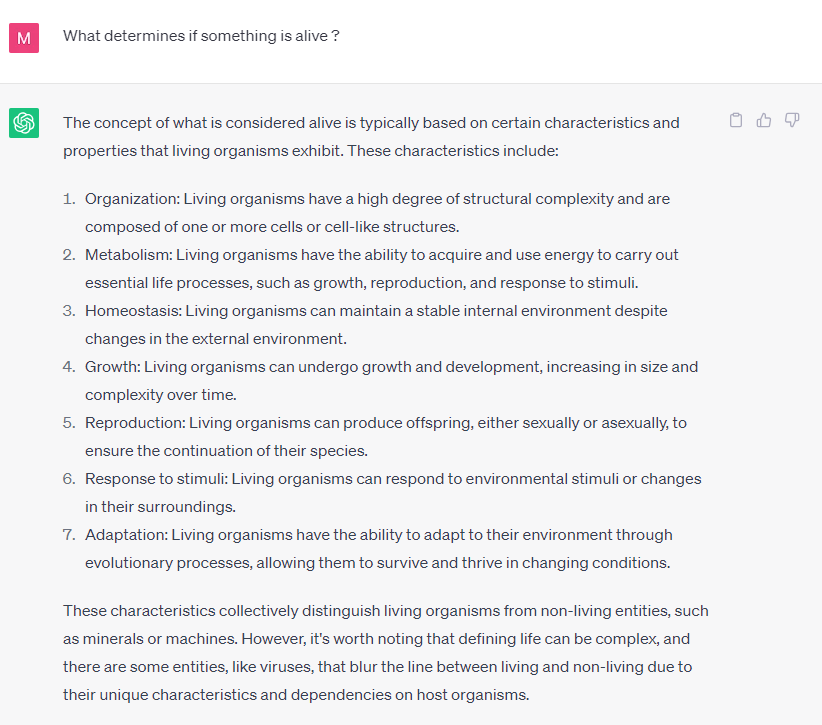
That’s interesting. I would say that a MicroStrategy installation can meet some of these requirements. How much is met depends on debate, and your desire to make facts fit a hypothesis. Without thinking too much about it, the match is good on organisation, homeostasis and response to stimuli. You could cheat and say that, through symbiosis with humans, it can also achieve growth, adaptation, metabolism and reproduction.
So what would it take to bring it to life ?
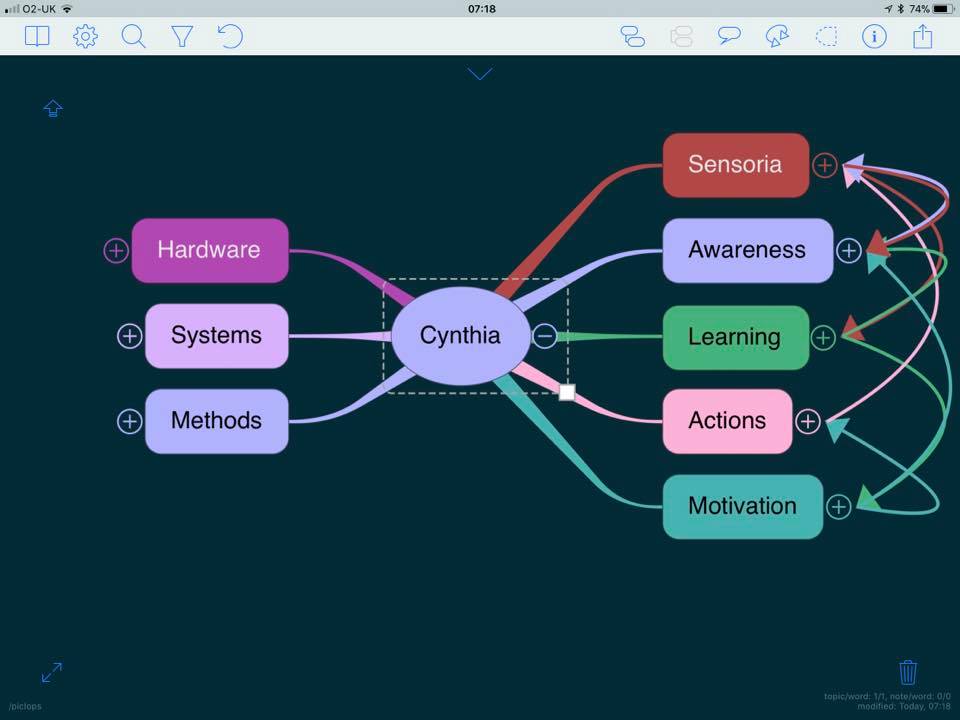
A while ago, I amused myself by modelling what a synthetic personality would look like. The image above shows a high-level view of Cynthia. The lower levels exist, but I am not sharing them yet :). Cynthia has some aspects which if created could be added to MicroStrategy to give it agency. Whether you would want to do this is another matter… I reckon that a team of decent game programmers could achieve this.
But the article talks about the Semantic Graph ! What about it ?
Many advanced lifeforms have a nervous system that stores memories and knowledge, responds to stimuli and takes action, and develop, through learning and evolution, purpose and motivation.
I suggest that, were a MicroStrategy installation a living thing, then the semantic Graph would be its nervous system. This nervous system evolves, and knows about its environment, not only through a mixture of symbiotic impulses from users, architects and administrators, but through its own sensorium via diagnostics and Platform Analytics. It is capable of translating data into information, for now through human configuration, but eventually I see it using an artificial intelligence adjunct.
So what is the Enterprise Semantic Graph ?
There are many ways to explain this. For me, it’s a member of a trinity of domains: You have the software, the data and the Enterprise Semantic Graph. It’s an ordered, connected collection of objects that describe and govern the configurative and transformative processes that the software uses to transform and present the data.

The image above shows a very simple semantic graph. Below is rather more complex one:
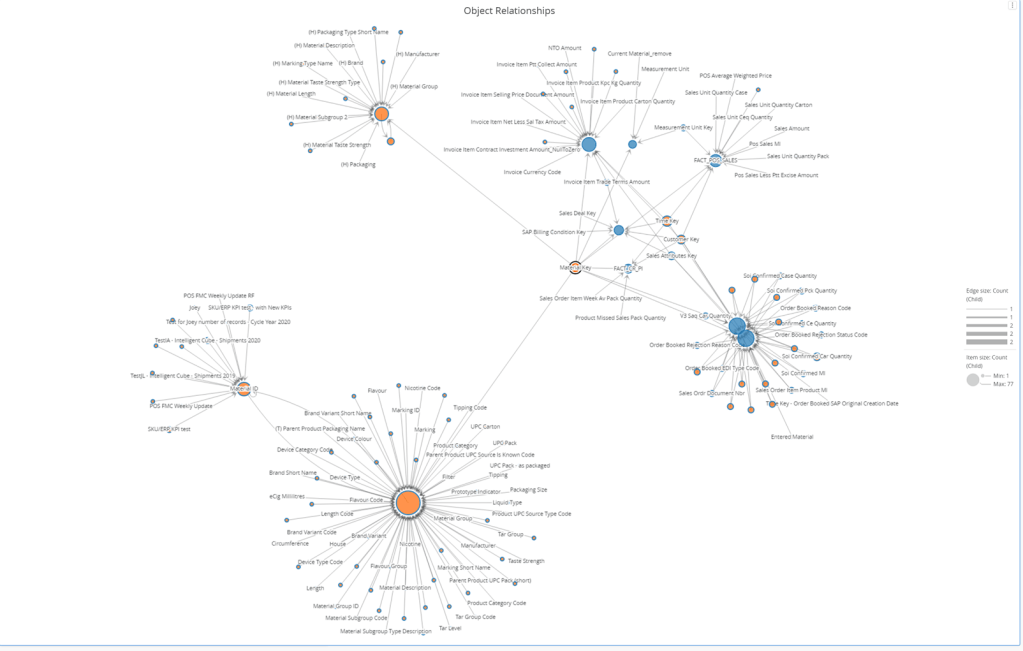
Again, this is a tiny portion of an Enterprise Semantic Graph. For those who know MicroStrategy, the term Schema is often used as a substitute. But that’s a simplification. Limiting the ESG to a collection of tables, attributes, metrics, facts, filters, reports, dossiers only gives you part of the story. I affirm this because I have spent quite a bit of time trying to visualise the ESG in a way that is easy to comprehend and to navigate. And the more I tried, the more I realised the following:
- It’s too big to encompass in one go.
- I am missing a number of dimensions to really understand how a system behaves.
- The visualisation mechanisms, out of the box, and even looking further afield in Python graph visualisation libraries, are inadequate to perform the task correctly.
Which is a shame, because if I wanted to fit MicroStrategy with an AI personality module, I would really need to research in depth the pathways and patterns that make up the ESG.
Let’s look at the above points, starting with point 1. The ESG, for a mature installation, is enormous. You can easily reach tens or hundreds of thousands of objects and their interconnections. With point 2, you need to enrich the ESG with the following:
- Platform Analytics data
- Subscriptions and schedule events
- Telemetry from the underlying systems
- Groups and their users, and the networks they form across projects
- I’m not even sure the list stops there !
And, finally, point 3. How do you visualise such a complex network ? You can only ever see a portion of it, it’s like looking at a landscape through a keyhole. However:
In my younger days, at university, my final year project was a VR world generator that used BI and MIDI data as a basis for objects in the world. But now we have AI, what I am tempted to do is to take the ESG and all the other data highlighted in point 2, capture the relationships, tokenise them and ask an AI to build me a virtual word with it that I could explore.
Would the world look like this:

Or would it look like this:

I am not sure such an AI exists. Yet. Furthermore, it would seem a complete departure from the theme of this article, if it were not to confirm that there is enough richness and depth in the ESG to achieve complex, living (in the cybernetic sense) structures, be they worlds representing their complexity, or minds managing the MicroStrategy installation.
A call to action
We live in times that I used to read about in science fiction books a few decades ago. With advances in AI, I believe we should go full speed ahead and either invent a way to navigate MicroStrategy as you would in a game like No Man’s Sky, or that you should build and train an AI to administer a MicroStrategy installation. Give me a few billion and I’ll do it.






![By Enterprise-D_crew_quarters.jpg: Derek Springer from Los Angeles, CA, USAPatrickStewart2004-08-03.jpg: Cdt. Patrick Caughey[1]derivative work: Loupeznik (talk) - Enterprise-D_crew_quarters.jpgPatrickStewart2004-08-03.jpg, CC BY-SA 3.0, https://commons.wikimedia.org/w/index.php?curid=17031867](https://datadiscovery.blog/wp-content/uploads/2020/02/jean-luc_picard_2.jpg)












 A Blog about Data
You must be logged in to post a comment.