
![By Enterprise-D_crew_quarters.jpg: Derek Springer from Los Angeles, CA, USAPatrickStewart2004-08-03.jpg: Cdt. Patrick Caughey[1]derivative work: Loupeznik (talk) - Enterprise-D_crew_quarters.jpgPatrickStewart2004-08-03.jpg, CC BY-SA 3.0, https://commons.wikimedia.org/w/index.php?curid=17031867](https://datadiscovery.blog/wp-content/uploads/2020/02/jean-luc_picard_2.jpg?w=739)
The thing with quadrants is that you can bend them to many uses. In the above-mentioned article, I express reservations about their value if you do not investigate the methodology and the data that they summarise.
As you know, I have been writing a series of articles about employee engagement, and I am of course very much behind with the latest and hopefully final instalment… But as a side project, it came to me that you could re-purpose the Clausewitz Quadrant to classify individuals into categories defined by their industriousness and engagement, or lack of it.
So here goes:
The Picard Quadrant – the axes

The X-axis is the same as the Clausewitz, ranging from Lazy to Industrious, but in the engagement context:
- Lazy means an aversion to working hard for hard work’s sake.
- Industrious means a strong determination to accomplish tasks and acquire new tasks as they become available.
The Y-axis now replaces Intelligence with Engagement. In many occupations nowadays, a modicum of intelligence is an entry-level requirement, so this measure is no longer appropriate. The axis now ranges from Indifferent to Engaged:
- Indifferent means not caring at all about the big picture and simply doing the job, no more, no less, with little regard to participation in the organisation’s mission.
- Engaged means looking beyond the boundaries of one’s position in the organisation, working to achieve the mission and to grow one’s career in synch with the progress of the wider team.
Let’s now look at the four quadrants in turn.
1:Indifferent and Lazy
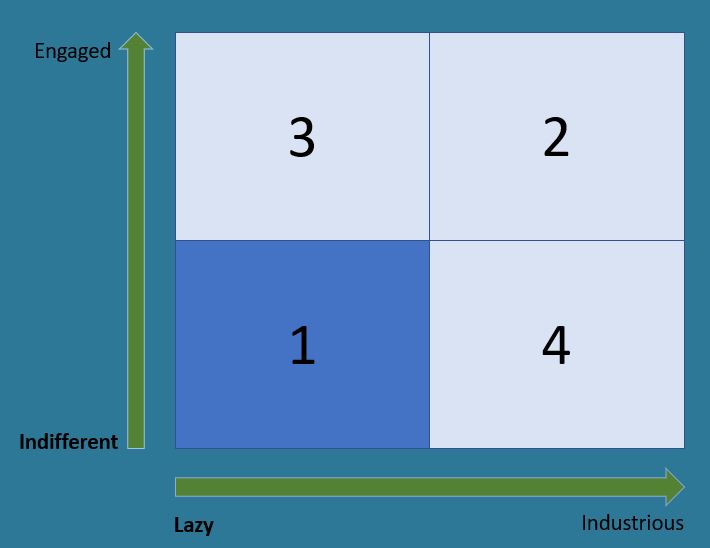
The Lazy and Indifferent category, in the private sector, is an endangered species. Efficiency pressures do not make a favourable environment for such individuals.
They will tend to work in areas that are either automated or outsourced. The increasing privatisation of the public sector is also narrowing the field in which such individuals can exist.
This means that, generally, it becomes important to find an occupation where the individual actually cares for, and thus engages in, the organisation that employs them.
2:Engaged and Industrious
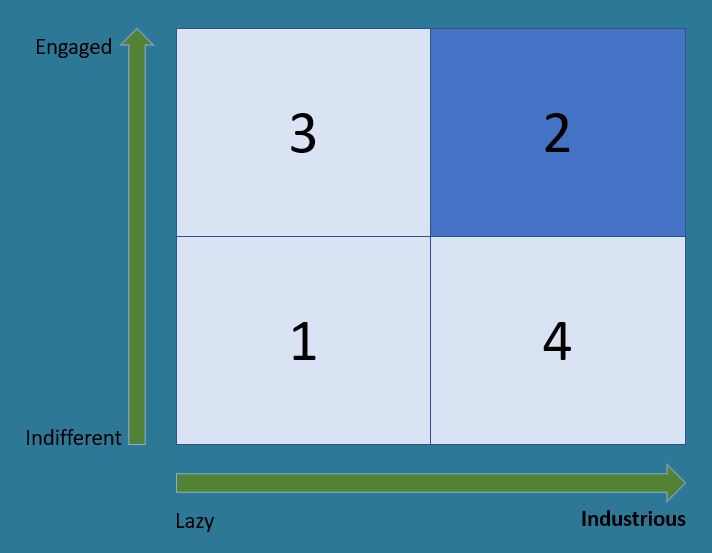
Being Engaged and Industrious is an absolute gift to an organisation. Many tasks can be given to these people, and they will thrive on the challenge.
Furthermore, they are keen to take on more work but run the risk of burning out.
The astute leader will know how hard to drive and challenge such people to get the best sustainable yield.
Such people can often over-commit to deliverables and may be disappointed when colleagues or events do not follow their pace.
3:Engaged and Lazy
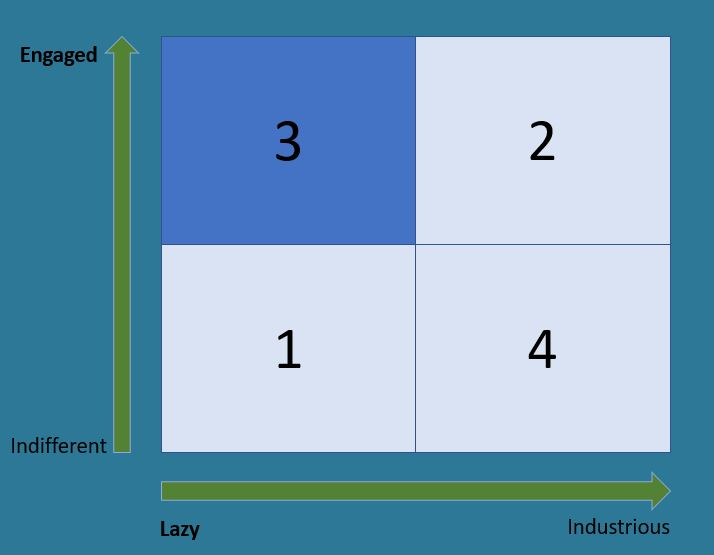
Being Engaged and Lazy is an attribute that should be valued providing an organisation is not entirely composed of such persons.
People who seek to get the best yield out of the lowest amount of work possible will look for efficiency and simplicity in order to get the tasks done. They will also have bandwidth to look at the bigger picture and may provide or enhance strategic decisions.
As such, they can also think laterally and reach innovative solutions which would elude their more industrious peers.
They do need to be led and motivated to keep the lazy side of their nature under control. Promotion is often a method used to get the best out of this category.
4:Indifferent and Industrious

This is quite a difficult category, if the person in question is at a lower hierarchical level, or plays a key part in a process at any level.
The typical behaviour is one where there is competency and knowledge, but solely in the execution of a defined set of tasks without any regard for the welfare and evolution of the organisation or the colleagues.
Such individuals do not welcome change and will be inflexible when thinking out of the box is required. This is increasingly a toxic attitude in today’s workplace and should be remedied by appropriate coaching.
So does this quadrant have any value ?
I think it does. As with the original quadrant, it’s a blunt tool, using axes whose values are almost impossible to measure. Its purpose is clear, however: To illustrate the value of engagement and the varying ways in which engagement benefits an organisation and its individuals.
Crucially, it also highlights the danger of having a disengaged workforce. This must be remedied – by the organisation’s leadership applying relevant coaching, or by the individual by finding an occupation where engagement will occur.
Increasingly the world of work will consist of leadership, ,supervisory or creative tasks. Processes will be automated by robots, machine learning and AI systems. Engagement will become a vital aspect of an employee’s value, for work to have any meaning beyond a simple means of subsistence.
This article is relevant to the next one in the works, where I describe an organisation where engagement is inevitable, and supported by numerous technologies, including, of course, MicroStrategy.
 A Blog about Data
You must be logged in to post a comment.