

This article is the second in a series leading up to a potential corporate cultural revolution enabled by one of the key technologies created by MicroStrategy, my employers. In this article I set up the importance of culture and value systems leading up to employee engagement.
I like studying history. In particular, the rise and fall of empires. There’s so much of history that crosses over into modern organisations, and yet so many lessons of history that do not get learned. I am taking the bold step of comparing corporations to civilisations, a valid one because both of them are human artefacts.
Culture is better than strength
I think it is evident that for a civilisation to last, to be remembered, to be influential, a strong culture is key. Examples abound: Look at the influence of Greece and Rome on the development of the West, the contribution that the Arab world made to science and medicine, the absorption of Kublai Khan’s Mongols by the apparently subjugated China, the survival of the English language in Great Britain despite the French-speaking Normans. During my exploration of this topic, I have noticed that purely military civilisations do not last as long as those with a powerful culture.
A powerful culture, supported by writing, laws, art, religion, can last way beyond the physical presence of the civilisation that gave birth to it.
How culture fares in a corporation
But is that a desirable feature for a modern organisation ? In fact, in these days of re-branding, of mergers and acquisition, it seems to me that corporate culture is an ephemeral thing, and sometimes culture is seen as an obstacle to the functioning of a free-market economy. How many times do you see the word ‘culture’ used in negative terms, being associated with resistance to change or deleterious practices ? For the modern corporation, a shift in culture is often seen as a key way to effect change. Whether that change is to benefit the shareholders or the employees (usually the former) is a subject for another article. Whether this culture change is carried out with regard to its impact on people is also another matter…

Change is inevitable
And yet, moving back to the domain of civilisations rather than corporations, it’s important for a culture to adapt with the times, to withstand shocks such as natural disasters, scientific discovery or religious and political upheaval. What matters is that the civilisation emerges from the metamorphosis enhanced, and ready to prosper and expand under new parameters. Maybe this is what happens with corporations, except that what I find missing is a level of continuity that could foster a sense of belonging by those who take part in it.
What is a culture ? It is, until we can understand whale-speak, a uniquely human artefact. Put simply, it is a combination of shared history, language, values and creations that underpins a civilisation. A corporation also has these components. I suggest that where a corporation and a civilisation part ways is in the purpose: A corporation has a defined goal: Make things, make money, create value and so on. A civilisation’s purpose is, again simply put, to endure.
Corporations do not endure. Or if they do, they no longer really resemble the original state they were founded in. This may be because the external forces that are applied to a corporation force change at a far greater pace.
Is this a good thing or a bad thing ? it all depends on the perspective. For the owners, or the shareholders, it’s essential that the vehicle through which they derive their wealth can adapt to changing environments. For them, the cultural metamorphosis is a good thing.
For the workers, it’s often a bad thing because a rapid change of purpose where elements of the corporate culture might disappear can cause disengagement and loss of motivation, or worse a loss of employment.
Just to get this in: I particularly abhor the concept of “business process engineering” because it is a thinly veiled euphemism for large-scale job losses. It was a concept that emerged in full in the 1980s, and many of the texts I have read on the topic gloss over the human element. It’s very ‘last millenium’, don’t you know.
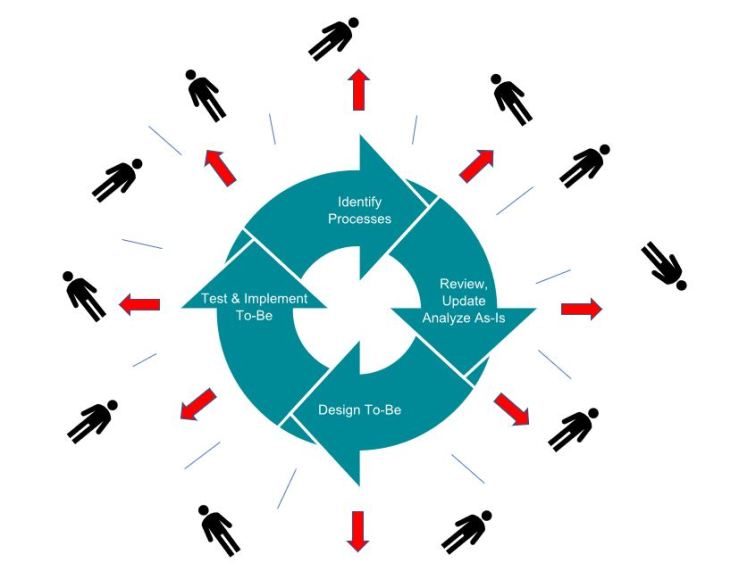
When the jobs start disappearing, and the shared history fades away, it might be seen as a necessity by the leaders and the owners, but this does not mitigate the loss felt by those whose purpose has ceased to exist.
Sadly, we have to accept the inevitable – corporations that cannot change are eventually doomed. So are civilisations, although in this case their culture might survive. I don’t think you can say the same about corporations.
Shared Values

Before I finally talk about employee engagement, I need to talk about shared values. As I said previously, civilisations and corporations have a common component, a set of values or behaviours which, in the case of corporation, should support its goals and its purpose. How these values help the achievement of the purpose has to be signed up by all in the organisation, in total transparency. Fail to do this and cynicism about the leadership’s intentions will spread like a nasty stain through the corporation’s morale.
Workers should not accept toiling to enrich the leaders or the owners without a fair reward for their work, and an understanding of its value for the organisation. They should also not accept a set of values that are not endorsed by all in the organisation.

This may sound a bit socialist to you, and it’s certainly an aspiration in many cases. But in our coming world of automation, the commoditised employee is an endangered species… I see it everywhere: repetitive, predictable tasks are increasingly performed by robots or proto-AI devices.
The human element is no longer a cog in the machine – it becomes a supervisory agency that guides and controls the machines to deliver a purpose or an outcome. Again, the social impact of automation is another rabbit-hole, nevertheless it is crucial that, in their new supervisory roles, workers and leaders share the same values, and perforce the same engagement.
Employee engagement, at last…
So what does employee engagement actually mean ? Is this another unreasonable ask by leaders and owners: We don’t want you to simply work for us, we want you to invest yourself in us.
This is a big commitment – instead of seeing employment as a means to earn an income, strictly bounded by working hours where the employee switches the work mindset on and off on a defined basis, engagement means that the job requires an elevated level of focus closer to what is normally reserved for raising a family, or pursuing a cultural or sporting activity. The employee needs to care, and will probably think about work outside of the normal working boundary.
This is fine if it works both ways: the employee has to have a clear reward path that is congruent with career aspirations. It’s a matter of strategic alignment: if this is not the case, then one party or the other does not benefit from the relationship, and an adjustment is required.
The Chief Culture Officer
Yet another silly title, you might think – but actually, if there is one hat amongst many that a Chief Executive must wear, defining and promoting a corporation’s culture might be the most important one. Done right, it provides a value framework where employee engagement occurs naturally. If I may refer to one of my previous articles : Leadership Observations: The Resistor-Capacitor Theory , this cultural messaging is of paramount importance, given the right balance.
Closing off – for now
I could ramble on for pages and pages about this. So it’s time to pull together the loose strands of this article and lay the groundwork for my definition of employee engagement:
Given a good cultural fit, and a realistic set of values that are followed by all, it should be possible to nurture employee engagement providing a strategic alignment exists between the goals of the employer and the employee.
My next article will describe one of the methods by which employee engagement can be fostered. And yes, it will be time to pay tribute to my esteemed employers because I will use a key technology of theirs to enable this method.
 A Blog about Data
You must be logged in to post a comment.