

The good thing about a blog is that you can write about stuff you experience and observe, but which might not be correct because it’s just your recollections and perceptions, there’s no deep research and no financial or professional motivation.
One such thing I want to talk about is leadership. Many, many books, courses and articles exist on the topic and I have read none of them ! But I have worked in organisations all my life, and not being a senior exec or a CEO I have been the recipient of leadership in a variety of forms. I also observe the leadership styles that members of my social circle experience, and there are a few interesting strands that emerge from this lazy yet curious study.
One such observation is about the role and type of the top person of an organisation, the CEO. I find that there are two main categories for this person: Driven, visionary leaders with absolute belief in their missions who direct their subalterns with intensity; and detached, discrete individuals who leave the leadership message up to their immediate reports.
Let’s call the combination of the CEO and immediate reports the Leadership Engine. This construct guides the organisation and executes strategy. Depending on the class of leader, the subalterns will behave in one of two roles:
The Resistor: When the leader is very strong and intense, the subaltern will need to have the capacity of translating the blast of leadership messaging into guidance and instruction that can be executed by the underlying reporting chain. Without this message damping system, the lower ranks of an organisation will not function effectively as they will not be able to withstand the force of the message. I call these message-attenuating subalterns resistors.
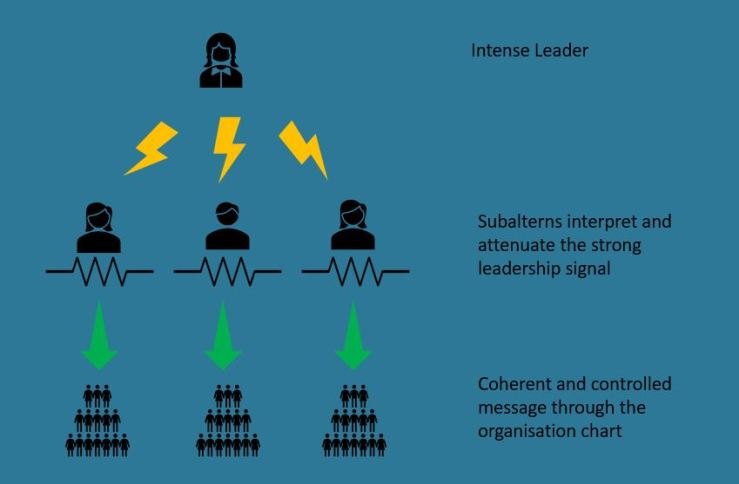
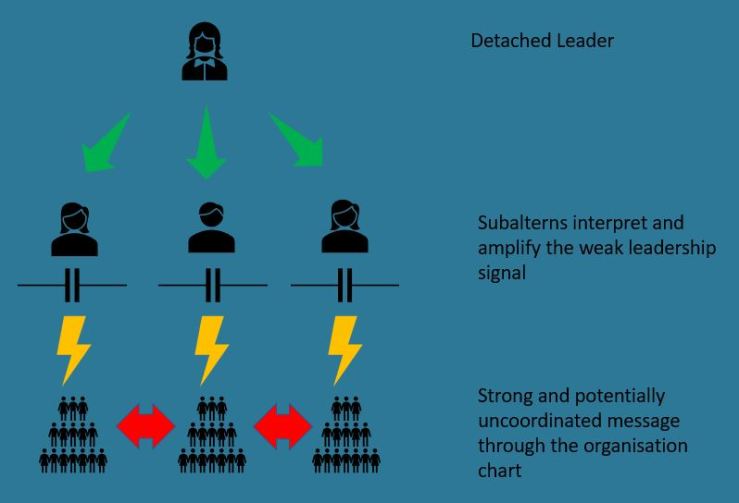
The Capacitor: When the leader is less hands-on, more theoretical than practical, the subalterns will need to provide the leadership strength that might be lacking. These subalterns become leaders in their own right, and the executive team becomes more like a federation of fiefdoms with the CEO as a ceremonial head. I call these message-amplifying subalterns capacitors.
In my experience, a resistor style leadership team is strong on execution but weak on confidence in the lower ranks and may stifle the innovation and engagement flow across the organisation chart. It may not be capable of challenging the leadership message which could lead to poor decisions lacking a critical evaluation.
A capacitor style leadership team will perform well within the functional streams, but may become inefficient or even dysfunctional if the capacitor coordination is poor, or adversarial.
Each style has its advantages and its downsides. It is down to the leadership to recognise where the strengths reside, and where counter-productive behaviours need to be mitigated by accepting a constructive critique. When you consider the type of individuals that can be found in leadership teams, this is not always an easy task.
And yet, this is increasingly important, because the most important asset in a modern organisation is the talent of its workers, at all levels. Tuning the leadership style to get the best sustainable yield is an essential, ongoing task.
So which type of leadership engine works best ? This is where some more serious research would be needed. Ah, given infinite amounts of time, what wonders we might reveal (probably not).
And that’s where my thinking stops for now. I am, after all, merely a person who plays with data for a living, not a management consultant. I have had the good fortune of encountering effective leadership in my career: I would not hang around very long in a company that didn’t get that right.
 A Blog about Data
[…] where employee engagement occurs naturally. If I may refer to one of my previous articles : Leadership Observations: The Resistor-Capacitor Theory , this cultural messaging is of paramount importance, given the right […]
LikeLike