The business world is full of contrived metaphors. Maybe this is done to give sparkle to topics which can be a bit dry or complex to get across. Over the last few weeks I have started using analogies from the world of transport to put across concepts that were not embedding themselves easily enough in the minds of my audience.
This article stems from reflections I had when thinking about the environment, or forces, that act upon any project or endeavour which involves change or innovation (pretty much everything I am involved in these days).
I do love aeroplanes. They are one of our most wondrous achievements, in my opinion. In particular, I love the Spitfire. It is difficult for me, when seeing them in flight (Duxford Air Show ! You must go !), to repress a shudder of delight as they fly overhead, with the outraged howl of the Rolls Royce Merlin engine.
You cannot love aeroplanes without knowing about the physics that permit them to fly. My understanding is that there are four forces that play together to give the plane motion and control:
- Thrust (provided by the engine)
- Drag (Resistance to the passage of the plane through the atmosphere)
- Lift (a force generated by the shape of the wings, caused by pressure differentials underneath and above the wings)
- Gravity (Our dear planet’s attempt to keep things close to her)
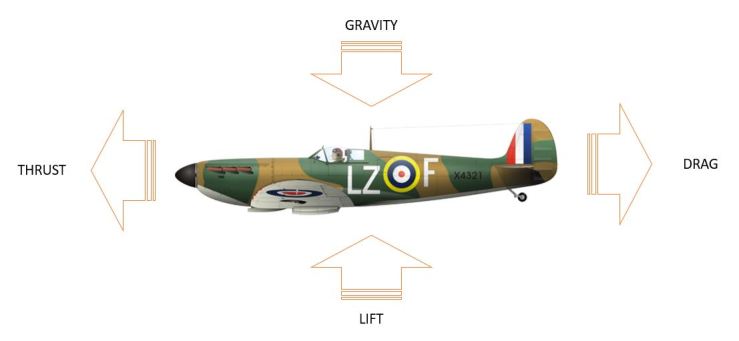
The modulation of these forces through control surfaces and power input results in the aeroplane performing as the pilot desires. Losing control of one or more of these forces tends to lead to undesirable outcomes.
Looking at projects, or any endeavour that requires changing from one state to another, I came to the realisation that you could model the forces effecting the progress of a project in a very similar way to those acting on an aeroplane. Thus, substitute:
- Thrust with Innovation ( the desire to change or improve something).
- Drag with Resistance to Change ( the work you have to do to bring others along with you )
- Lift with Agility (the ability your organisation has to effect that change rapidly)
- Gravity with Governance (the function that controls and governs the rate of change so that it fits with statutory or strategic goals)

The role of the aeroplane’s pilot is similar to that of the project manager, who has to have knowledge of the extent and nature of the forces assisting or impeding the endeavour to lead it to its satisfactory conclusion. The four forces exist in varying quantity and quality from organisation to organisation, and are mainly an outcome of the blend of leadership, regulatory or competitive forces and established practices.
It’s clear that if these forces are out of balance, a supplementary input of resource will be necessary for the project to reach its conclusion. For instance, an excess of resistance to change will need to be countered by an increase in the outreach and mitigation of this resistance. It will take more time and cost to get to the destination. Similarly, an excess of governance will cause friction in the project’s progress, whilst uncontrolled innovation may not be beneficial to an organisation’s overall strategy.
Like most business metaphors, this one will not stand the scrutiny of an aeronautics engineer as there are clearly many other factors that affect the performance of an aeroplane. I may even have got the physics wrong… But I am pretty certain that an astute project manager, who understands the extent and nature of the forces that influence the progress and outcome of an endeavour, stands a far better chance of leading it to its conclusion.
It is also down to the leadership of organisations to get a grip on the supply and nature of these forces, and to put in place the right balance so that a majority of projects succeed in reaching their destination.
 A Blog about Data
You must be logged in to post a comment.